
Cytochrome c oxidase inactivation in Physcomitrium patens reveals that respiration coordinates plant metabolism
The Plant Cell 2025. DOI: https://doi.org/10.1093/plcell/koaf101
View Abstract
Photosynthetic organisms use sunlight as an energy source but rely on respiration during the night and in nonphotosynthetic tissues. Respiration also occurs in photosynthetically active cells, where its role is still unclear due to the lack of viable mutants. Mutations abolishing cytochrome c oxidase (Complex IV) activity are generally lethal. In this study, we generated cytochrome c oxidase assembly protein 11 (cox11) knockout lines through vegetative propagation in the moss Physcomitrium patens. These mutants showed severely impaired growth, with an altered composition of the respiratory apparatus and increased electron transfer through alternative oxidase. The light phase of photosynthesis remained largely unaffected in cox11 plants, while the efficiency of carbon fixation was reduced. Transcriptomic and metabolomic analyses showed that disrupting the cytochrome pathway had broad consequences for carbon and nitrogen metabolism. A major alteration in nitrogen assimilation was observed, with a general reduction in amino acid abundance. Partial growth rescue was achieved by externally supplying plants with amino acids but not with sugars, demonstrating that respiration in photosynthetic plant cells plays an essential role at the interface between carbon and nitrogen metabolism and a key role in providing carbon skeletons for amino acid biosynthesis.

Alternative Oxidase Enhances Metabolic Flexibility in Bioenergetic Metabolism of Physcomitrium patens
Authorea (preprint) 2025. DOI: https://10.22541/au.175152257.75470323/v1
View Abstract
Mitochondrial respiration catalyses the electron transfer from NADH to oxygen through the activity of Complex I, II, III, and IV. Plant mitochondria possess additional alternative electron transport pathways, including one mediated by alternative oxidase (AOX), which transfers electrons from ubiquinone to O 2, bypassing the cytochrome-dependent electron transport chain. This study investigates the functional role throughout plant evolution by analysing Physcomitrium patens plants missing or overexpressing AOX. In the moss P. patens, AOX has a remarkably high electron transport capacity and can fully compensate for the cytochrome pathway. AOX overexpression led to growth inhibition, possibly due to excessive energy dissipation. Despite the high potential activity, aox KO lines did not show significant impact in growth or photosynthetic activity under various conditions, due to the compensatory action of the cytochrome pathway. When the cytochrome pathway was inhibited, AOX activity impacted photosynthetic reactions, affecting in particular chloroplast ATPase. Simultaneous inactivation of AOX and complex III resulted in plant lethality, demonstrating the essential role of mitochondria respiration for plants cells, specifically in balancing reducing power and ATP availability. AOX thus enables mitochondria to sustain the oxidation of reducing equivalents even under conditions in which ATP consumption is saturated, providing flexibility to the bioenergetic metabolism.
Light intensity activation of alternative electron transport mechanisms in the moss Physcomitrium patens
Plant Physiology and Biochemistry 2025. DOI: https://doi.org/10.1016/j.plaphy.2025.109904
View Abstract
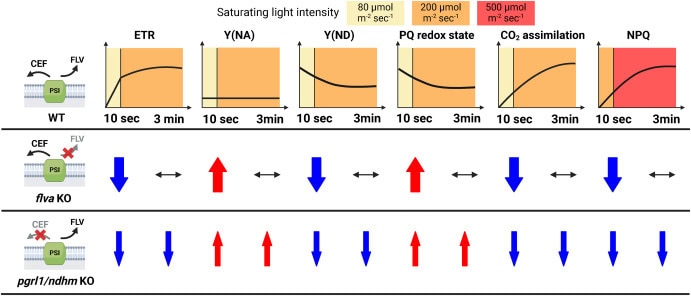
Photosynthetic organisms exploit sunlight to drive an electron transport chain and obtain the chemical energy supporting their metabolism. In highly dynamic environmental conditions, excitation energy and electron transport need to be continuously modulated to prevent over-reduction and the consequent damage. An essential role in the regulation of electron transport is played by alternative electron transport mechanisms such as cyclic electron transport (CET) facilitated by PGRL1/PGR5 and NDH complex and pseudo-cyclic electron transport (PCET) mediated by the flavodiiron proteins (FLV) and the Mehler reaction.
In this work mutant lines of the moss Physcomitrium patens depleted in PCET (flva KO) or CET (pgrl1/ndhm KO) were compared to wild-type plants for their ability to regulate photosynthetic electron transport in response to light fluctuations of different intensities. FLV activity enables a very fast increase in electron transport capacity but its impact is transient and becomes undetectable after 3 min from a light change. The FLV electron transport capacity is saturated at 100 μmol photons m−2 s−1 and does not increase even if exposed to stronger illumination. On the other hand, CET activation after an increase in illumination has a smaller contribution on electron transport capacity, but it provides a steady contribution for several minutes after a change in illumination intensity.
Overall, these results demonstrate that light adapted plants CO2 fixation capacity needs approx. 3 min to adjust to different illumination intensities. In this interval CET and PCET enable adjusting temporary unbalances in electron transport, fully responding to 2–4 time increases in illumination. In case of larger increases, these mechanisms still contribute to protection from light damage by reducing the accumulation of electrons at PSI acceptor side. While the two mechanisms play an overlapping function, their activity shows distinctive kinetics and electron transport capacity thus they are complementary in ensuring optimal photoprotection.

Mitochondrial respiration is essential for photosynthesis-dependent ATP supply of the plant cytosol
New Phytologist 2024. DOI: https://doi.org/10.1111/nph.19989
View Abstract
Plants rely on solar energy to synthesize ATP and NADPH for photosynthetic carbon fixation and all cellular need. Mitochondrial respiration is essential in plants, but this may be due to heterotrophic bottlenecks during plant development or because it is also necessary in photosynthetically active cells.
In this study, we examined in vivo changes of cytosolic ATP concentration in response to light, employing a biosensing strategy in the moss Physcomitrium patens and revealing increased cytosolic ATP concentration caused by photosynthetic activity.
Plants depleted of respiratory Complex I showed decreased cytosolic ATP accumulation, highlighting a critical role of mitochondrial respiration in light-dependent ATP supply of the cytosol. Consistently, targeting mitochondrial ATP production directly, through the construction of mutants deficient in mitochondrial ATPase (complex V), led to drastic growth reduction, despite only minor alterations in photosynthetic electron transport activity.
Since P. patens is photoautotrophic throughout its development, we conclude that heterotrophic bottlenecks cannot account for the indispensable role of mitochondrial respiration in plants. Instead, our results support that mitochondrial respiration is essential for ATP provision to the cytosol in photosynthesizing cells. Mitochondrial respiration provides metabolic integration, ensuring supply of cytosolic ATP essential for supporting plant growth and development.
 Top viewed article - Among the top 10% of most-viewed papers published by New Phytologist in 2024
Assessment of photosynthetic activity in dense microalgae cultures using oxygen production
Plant Physiology and Biochemistry 2024. DOI: https://doi.org/10.1016/j.plaphy.2024.108510
View Abstract
Microalgae are photosynthetic microorganisms playing a pivotal role in primary production in aquatic ecosystems, sustaining the entry of carbon in the biosphere. Microalgae have also been recognized as sustainable source of biomass to complement crops. For this objective they are cultivated in photobioreactors or ponds at high cell density to maximize biomass productivity and lower the cost of downstream processes.
Photosynthesis depends on light availability, that is often not constant over time. In nature, sunlight fluctuates over diurnal cycles and weather conditions. In high-density microalgae cultures of photobioreactors outdoors, on top of natural variations, microalgae are subjected to further complexity in light exposure. Because of the high-density cells experience self-shading effects that heavily limit light availability in most of the mass culture volume. This limitation strongly affects biomass productivity of industrial microalgae cultivation plants with important implications on economic feasibility.
Understanding how photosynthesis responds to cell density is informative to assess functionality in the inhomogeneous light environment of industrial photobioreactors. In this work we exploited a high-sensitivity Clark electrode to measure microalgae photosynthesis and compare cultures with different densities, using Nannochloropsis as model organism. We observed that cell density has a substantial impact on photosynthetic activity, and demonstrated the reduction of the cell's light-absorption capacity by genetic modification is a valuable strategy to increase photosynthetic functionality on a chlorophyll-basis of dense microalgae cultures.

High-resolution photosynthesis-irradiance curves in microalgae
Bioenergetics Communications (BEC) 2022. DOI: https://doi.org/10.26124/bec:2022-0019
View Abstract
The rate of oxygen evolution provides valuable information on the metabolic status and photosynthetic performance of a cell, and it can be quantified by means of a photosynthesis-irradiance (PI) curve. Up to now, the construction of PI curves of unicellular organisms based on oxygen evolution has been difficult and time consuming due to the lack of sensitive instruments. Here we describe the setup of a reproducible method for constructing PI curves based on oxygen evolution using small amounts of sample in the microalga Nannochloropsis gaditana, easily translatable to other algal species.

Acclimation of photosynthetic apparatus in the mesophilic red alga Dixoniella giordanoi
Physiologia Plantarum 2021. DOI: https://doi.org/10.1111/ppl.13489
View Abstract
Eukaryotic algae are photosynthetic organisms capable of exploiting sunlight to fix carbon dioxide into biomass with highly variable genetic and metabolic features. Information on algae metabolism from different species is inhomogeneous and, while green algae are, in general, more characterized, information on red algae is relatively scarce despite their relevant position in eukaryotic algae diversity. Within red algae, the best-known species are extremophiles or multicellular, while information on mesophilic unicellular organisms is still lacunose. Here, we investigate the photosynthetic properties of a recently isolated seawater unicellular mesophilic red alga, Dixoniella giordanoi. Upon exposure to different illuminations, D. giordanoi shows the ability to acclimate, modulate chlorophyll content, and re-organize thylakoid membranes. Phycobilisome content is also largely regulated, leading to almost complete disassembly of this antenna system in cells grown under intense illumination. Despite the absence of a light-induced xanthophyll cycle, cells accumulate zeaxanthin upon prolonged exposure to strong light, likely contributing to photoprotection. D. giordanoi cells show the ability to perform cyclic electron transport that is enhanced under strong illumination, likely contributing to the protection of Photosystem I from over-reduction and enabling cells to survive PSII photoinhibition without negative impact on growth.

Inactivation of mitochondrial complex I stimulates chloroplast ATPase in Physcomitrium patens
Plant Physiology 2021. DOI: https://doi.org/10.1093/plphys/kiab276
View Abstract
Light is the ultimate source of energy for photosynthetic organisms, but respiration is fundamental for supporting metabolism during the night or in heterotrophic tissues. In this work, we isolated Physcomitrella (Physcomitrium patens) plants with altered respiration by inactivating Complex I (CI) of the mitochondrial electron transport chain by independently targeting on two essential subunits. Inactivation of CI caused a strong growth impairment even in fully autotrophic conditions in tissues where all cells are photosynthetically active, demonstrating that respiration is essential for photosynthesis. CI mutants showed alterations in the stoichiometry of respiratory complexes while the composition of photosynthetic apparatus was substantially unaffected. CI mutants showed altered photosynthesis with high activity of both Photosystems I and II, likely the result of high chloroplast ATPase activity that led to smaller ΔpH formation across thylakoid membranes, decreasing photosynthetic control on cytochrome b6f in CI mutants. These results demonstrate that alteration of respiratory activity directly impacts photosynthesis in P. patens and that metabolic interaction between organelles is essential in their ability to use light energy for growth.